A sociocultural theory about an anime series that deals with real-life, heavy themes. Warning: MASSIVE spoilers ahead.
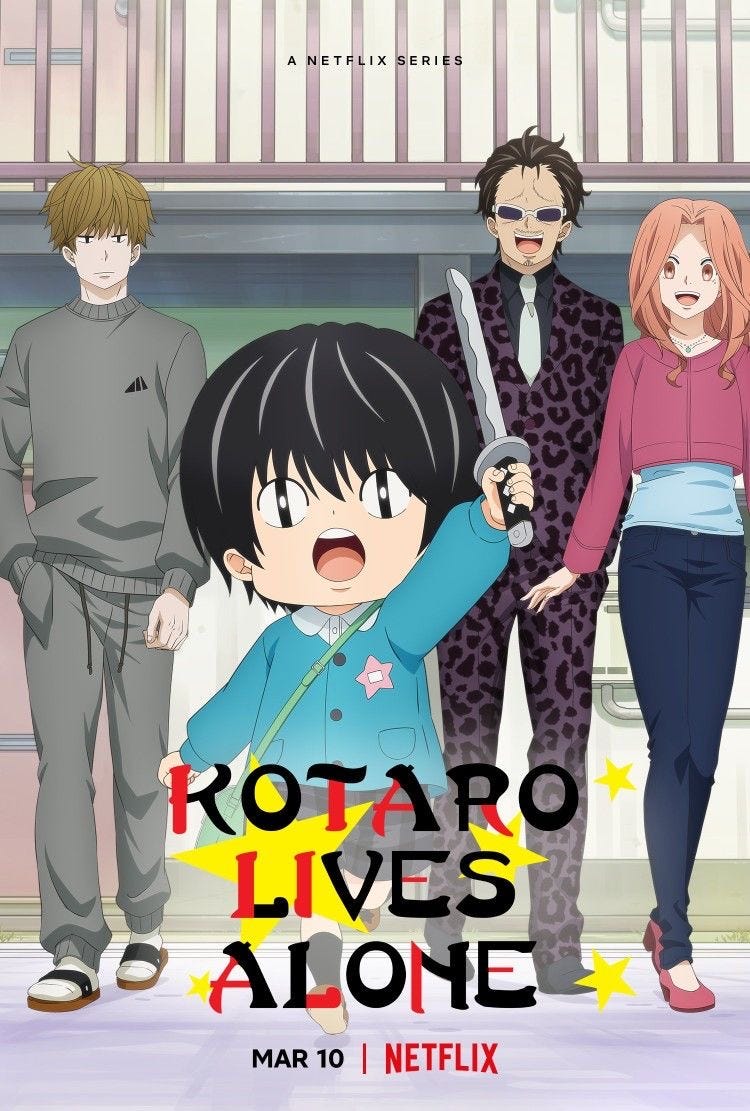

As I was rewatching the anime series “Kotaro Lives Alone” on Netflix, a thought that I had from the first time I watched it resurfaced. Because of this, and my fascination with sociocultural backgrounds, as well as a desire to analyze just about any entertainment that peeks my interest, I came up with a theory that makes an already sad anime even sadder: in “Kotaro Lives Alone”, Kotaro Sato’s mother, despite a long battle with postpartum depression, depression and/or some other mental health issues that she was unable or unwilling to get help for, while trying to keep it together on her own for her son, killed herself. One thing to keep in mind: I am only analyzing the anime, I haven’t seen the live adaptation or gotten my hands on the manga.
To summarize, the show is about a four-year-old boy named Kotaro Sato who lives on his own in a very cheap apartment complex, with neighbors that all look after this child the way neighbors should look after each other. The neighbors especially responsible, and the ones we see most often, are his next-door neighbor Karino Shin, a manga artist who’s dealing with pressure from his editor to produce better work, Isamu Tamaru, a divorced dad who gives off a gangster vibe and has taken a real liking to little Kotaro, and Mizuki Akitomo, Karino’s other next-door neighbor who works as a hostess and had to eventually move to get away from an abusive boyfriend, with the new neighbor Sumire Takei taking her place. Despite the issues they face in their own lives, they do what they can to try and keep an eye on Kotaro when they learn that he lives in the apartment on his own. They take this seriously to the point of his main three “guardians” even attempting to block his possibly abusive, but at the very least unstable, father from getting to the preschool at the slightest whiff of a detective hired by his father to find him in spite of a restraining order against him.
Things that set Kotaro apart from many kids his age, besides being on his own in an apartment complex, are his hyper-independence, being able to cook for himself and do other tasks seen as normal adult life in a way that’s as good as adults if not better than some, as well as his distinctive speech pattern, addressing everyone as “Sir___” or “Lady ___” among other ways of speaking like a little feudal lord. While the show does have its funny moments and a colorful cast of characters, the tone drastically shifts, discussing themes of loneliness, domestic violence, lingering effects of childhood abuse and neglect up to adulthood, parental alienation, and in every episode.
Overview of Postpartum Depression in Japan
Postpartum depression is characterized by various symptoms that can significantly impact a woman’s mental health. These symptoms include a persistent feeling of sadness or despair, loss of interest or pleasure in activities, sleep disturbances, changes in appetite, anxiety, irritability, and feelings of worthlessness or guilt. In the show, Kotaro’s mother is often seen very sad, even crying, in flashbacks.
In Japan, postpartum depression (PPD) affects approximately one in seven women and can have a lasting impact on their ability to function and their relationship with their infant.
However, the attitudes surrounding postpartum depression in Japan contribute to a significant stigma and make it challenging for women to seek help or receive the necessary support.
The prevalence and impact of postpartum depression in Japan are highly underestimated due to privacy conflicts and the stigma surrounding mental health issues, as well as pressures from a patriarchal society to conform to the roles of wife and mother, as they’re viewed as the most important roles a woman can ever have in her life. Many cases of PPD go undiagnosed and untreated, leading to detrimental effects on the well-being of mothers, fathers, and infants. In episode 5, when the pregnant in-store demonstrator explained that children are a gift for parents and he asked if he was a gift too. While the woman said he was, the fact he asked this question could show that he likely thought his parents loved him but didn’t see him as a gift, such as his mother having trouble bonding with him.
Several factors contribute to the stigma around postpartum depression in Japan. The traditional societal expectation for women to be stoic and self-sacrificing can lead to a lack of acknowledgement and understanding of maternal mental health issues.
Additionally, the pressure to conform to societal norms of motherhood and maintain a perfect image further contributes to the reluctance to seek help.
Early diagnosis and intervention are crucial in managing and treating postpartum depression effectively.
However, the prevailing stigma hinders women from voicing their struggles or seeking professional help.
Suicide in the West vs. Suicide in Japan
Attitudes towards suicide are vastly different in the West than they are in Japan. One influencing factor is the spread of Christianity in the West. In Christian traditions, especially Catholicism, suicide is seen as one of the worst things a person can do, as it guarantees a one-way ticket to Hell. No matter how the person suffers as they’re alive, they still must stay alive. Modern Western attitudes state things such as “a permanent solution to a temporary problem” or that it’s “selfish” or “the coward’s way out”. However, more modern Western attitudes are for seeking help instead of just suffering alone.
Unlike the West, Japan has a much more tolerant view of suicide. It has been viewed morally responsible at times, such as historical links between Seppuku of Samurai and later expanding it as a capital punishment that mandated for disgraced Samurai or laypeople as well as Kamikaze pilots of the Second World War.
In addition, there are other social pressures that contribute heavily to despondency. A phenomenon, known as amae, is the attitude that how one is seen by others is what that person is worth. What other people think affects people even more than it does in the West as reputation is everything. For example, a woman who struggles with motherhood may feel pressure to take her own life because she feels she’s failing at being a mother, a sentiment likely shared by neighbors and friends.
In the modern era, Japanese attitudes towards suicide have been changing since the 1990’s. A legendary suicide spot often has signs to try and deter people by encouraging them to seek help. Even so, depression and other mental health conditions contribute to 49% or all cases of suicide.
How does this fit into Kotaro Lives Alone?
It is shown in episode 3 that Kotaro lives on his mother’s life insurance but because he doesn’t have a bank account, his allowance from the life insurance has to be delivered every week. However, the lawyer who delivers it, Ayano Kobayashi, is strictly instructed to not tell him that it’s life insurance from his dead mother, but to instead say it’s from a “generous donor”, a statement that her predecessor also said, adding that it would be impossible to find and thank the “donor”. Kobayashi, moved by the story and her duty, requests to stay with the case as long as possible. She stays with the story of the “generous donor”, even when Kotaro gets her drunk from beers that were delivered to a neighbor in an effort to find out the truth in episode 4. In Episode 10, it is confirmed that Kotaro’s mother, Sayori, is dead when he and Karino clean her family graves and her name is seen on the grave by Karino alongside her long-dead parents. Karino also helped to protect Kotaro by refusing to move from the side that had Sayori’s name.
Kotaro has seen adults sad many times in his young life. In Episode 1, Miziki is seen drunkenly waving after waking up from passing out in her apartment doorway. While Kotaro probably didn’t understand that she was drunk, he did seem to know how to deal with a crying adult, as he and Karino went to a nearby convenience store to find some ice, bringing home a frozen drink to have her place it on her eyes to help soothe them. When asked, Kotaro states that he has seen adults cry many times. This is in spite of, or it perhaps causes, his refusal to be seen crying and weak, stating he hates crying. This is later confirmed in episode 7, where a flashback is shown of Sayori, Kotaro’s mother, crying at the table in the old apartment she used to live. In that same episode, Sayori told Kotaro she couldn’t take care of him anymore and wouldn’t be living with them. She did promise that she would be with him again, but she sounded very sad when she said this.
Those that are depressed often have trouble taking care of themselves and it could extend to their children. While she was shown to be negligent, being in episode 4 scrolling on her cell phone instead of paying attention to her son’s drawing and it was revealed in that Kotaro’s earlier neglect was severe enough to include dental problems like an abundance of cavities, she did seem to want to bond with her son, but had trouble doing so. In episode 8, Kotaro treasured a pair of gloves that his mother wore to be able to touch him despite the new neighbor recognizing it as a sign of abuse, as it is implied that their mothers need the gloves because they cannot bear to touch their children. In the next scene, Takei’s mother was overheard saying she couldn’t stand the sight of her, while Kotaro’s mother left without being heard saying she couldn’t stand her son.

In episode 2, he would act out scenes of his favorite cartoon character, Tonosaman, for the series finale of the show, and give a very small amount of money to passersby who watched him. However, he would only give money to people who laughed or smiled, stating bluntly “I have no business with you” if his improvised audience didn’t laugh. It is shown that his mother would often smile when she saw him act out the show, as he lamented that “10 yen isn’t enough”, alluding to the smiles he saw on his mother’s face. This could imply that she did have some love for him but was unable to take care of him.
In patriarchal societies, women are traditionally expected to love kids and be very good with them, as motherhood is deemed “the most important job a woman has”, judging women much harsher than men who are. Women who don’t fit this mold are often made to feel like failures. Japanese society is even more patriarchal than American society, with the concept of amae adding to pressure to women who suffer from postpartum depression and contributing to them feeling like failures if they cannot complete “the most important job a woman has”, making it even more difficult to seek help when needed. This was shown in episode 8, when Takei reveals that she is not comfortable around children or even good with them at all. As a result, she often deals with whispers and pressure and feels the need to “change” herself by performing a crude sort of exposure therapy on herself by forcing herself to be around children. Sayori likely also dealt with the same pressures, which could have exacerbated her depression and the feelings she had of being inadequate.
The combined factors of being pressured to fit into the mold of being excellent with children, mental health issues and a tolerance of suicide could have contributed to the death of Kotaro’s mother. If you are dealing with tough feelings, please seek help. You are not alone. While I cannot relate since I personally don’t have or want children, I can still want what is best for my readers.
Reference
- Postpartum Depression — StatPearls — NCBI Bookshelf
- Improving knowledge, attitudes and beliefs: a cross-sectional study …
- The complicated concept of suicide in Japan
- Watch Kotaro Lives Alone | Netflix Official Site
- Kotaro Lives Alone (TV Mini Series 2022) — IMDb
- Ayano Kobayashi, Kotaro Lives Alone wiki
- Isamu Tamaru, Kotaro Lives Alone wiki
- Mizuki Akitomo, Kotaro Lives Alone wiki
- Sumire Takei, Kotaro Lives Alone wiki
- Suicide in Japan: cultural aspects
- Tonosaman, Kotaro Lives Alone wiki